
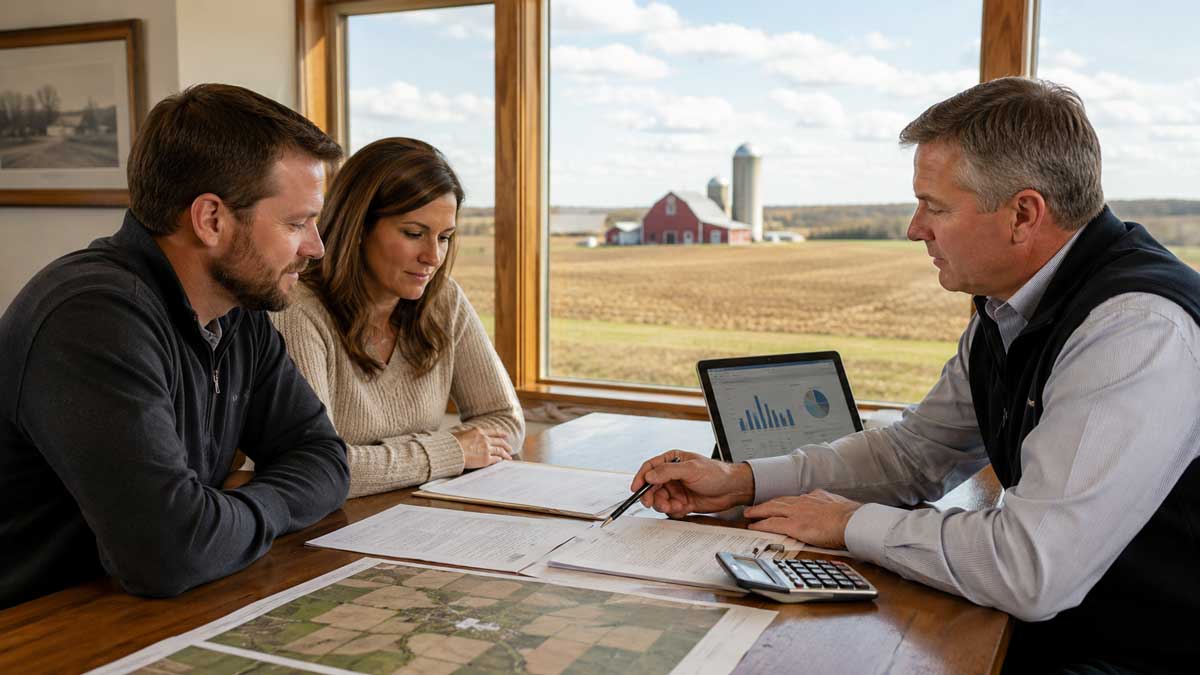
Sibling property buyout financing can become necessary when farmland passes between family members and one heir wants to retain ownership. Midwest landowners may have several lender options for agricultural real estate, with each offering different loan structures, equity requirements, and repayment terms.
Interest rates on sibling property buyout loans can vary across the region based on property value, borrower qualifications, collateral strength, loan size, and lender risk standards. Credit history can influence available terms, but the property’s appraised value and the overall structure of the transaction are also important.
Typical Midwest buyout loans use farmland as collateral and may include multi-year amortization schedules, defined equity requirements, and documentation covering ownership transfers. Substantial loan fees may also apply, including appraisal, title, legal, and closing expenses.
Understanding how lenders structure these transactions allows borrowers to compare the full cost of capital rather than focusing only on the stated interest rate.
Comparing Lender Options for Sibling Buyouts
Lender comparisons will play a major role in your sibling property buyout financing. Midwest markets include banks, agricultural lenders, and private lenders, each with its own requirements for farmland transactions.
It is difficult to compare options without first establishing the property’s current value and the amount required to buy out the other siblings. Start by identifying lenders that handle substantial agricultural real estate transactions and understand land-backed financing.
Most lenders consider the property’s appraised value, requested loan amount, borrower credit profile, existing debt, and available equity when establishing terms. Private lenders may place greater emphasis on the collateral and transaction structure than conventional lenders.
When comparing offers, review more than the interest rate. Equity requirements, amortization, closing costs, prepayment provisions, and funding timelines can materially affect the total cost of a sibling property buyout loan.
State-by-State Interest Rate Variations
State-level differences can influence how lenders evaluate agricultural property and structure sibling buyout loans. However, there is no single interest rate that applies to every borrower or farmland transaction within a particular state.
- Foreclosure and Recovery Considerations: State laws governing foreclosure and creditor remedies can influence lender risk. Illinois and Indiana, for example, generally involve judicial foreclosure procedures, which can affect the time and cost associated with recovering collateral. These factors may be reflected in overall loan pricing.
- Local Market Conditions: Farmland values, agricultural income, demand for rural property, and lender competition can differ considerably between states. These conditions may affect how a lender evaluates collateral and establishes loan terms.
- Lender Competition: Markets with several agricultural and private lending sources may provide borrowers with more opportunities to compare financing structures. Limited lender availability can reduce those options, particularly for larger or more specialized buyout transactions.
For borrowers comparing Midwest states, the relevant question is not simply which state has the lowest average rate. The better comparison considers the complete financing structure against the property’s value and the borrower’s repayment capacity.
How Credit Scores Impact Loan Offers
Credit history remains an important part of the underwriting process for sibling property buyout loans. It helps lenders assess repayment risk and determine how the proposed debt fits with the borrower’s existing obligations.
- Lower Credit Scores Can Increase Costs: A weaker credit profile may result in more restrictive terms, higher pricing, or additional equity requirements.
- Stronger Credit Supports Better Terms: A strong credit history can improve the borrower’s overall lending profile, particularly when combined with substantial farmland equity and reliable income.
- Existing Debt Matters: Lenders review current mortgages, agricultural debt, personal obligations, and other liabilities when determining whether the borrower can support the new loan.
- Credit Is Not the Only Factor: A strong score does not compensate for insufficient collateral, unclear title, weak repayment capacity, or unresolved disagreements among siblings.
For larger agricultural transactions, borrowers should evaluate their complete financial position before seeking final loan terms.
Typical Terms for Midwest Buyout Loans
Most sibling property buyout loans use farmland as collateral. Terms can include longer repayment periods, depending on the lender, property characteristics, loan amount, and borrower qualifications.
The amount required generally corresponds to the value of the departing sibling’s ownership interest, subject to the agreed valuation and lender appraisal. For example, if several siblings own farmland together and one wants to retain the property, the financing may be structured around purchasing the other owners’ documented interests.
Farm Mortgage Capital focuses on land-backed financing for substantial agricultural transactions. Its minimum loan size is $400,000, making the structure more relevant to higher-value farmland and ranch properties.
The final loan-to-value structure depends on the property’s appraised value, existing liens, borrower equity, and lender requirements. Clear title and an agreed buyout price are also important before financing can proceed.
Loan Fees to Consider Before Applying
There are several costs associated with farmland financing that borrowers should review before submitting an application.
- Origination Fees: Some lenders charge origination or underwriting fees based on the size and structure of the transaction. These costs should be included when comparing the effective cost of financing.
- Appraisal Costs: Professional farmland appraisals are commonly required to establish current collateral value. Complex properties, large acreage, improvements, or limited comparable sales can increase appraisal costs.
- Title and Legal Fees: Title searches, title insurance, deed preparation, and legal review can add costs to a sibling buyout, particularly when ownership has passed through several generations.
- Credit and Underwriting Charges: Depending on the lender and transaction, borrowers may incur fees associated with credit review, document processing, or underwriting.
- Recording and Settlement Fees: County recording charges and settlement expenses should also be included in the closing budget.
Reviewing these expenses alongside the interest rate provides a more accurate picture of total borrowing costs.
Evaluating Fixed Versus Variable Rates
Reviewing fixed and variable rate options is important when arranging a buyout of farmland among siblings. The choice affects payment predictability and long-term interest-rate exposure.
- Fixed Rate: Fixed-rate Farm Mortgage Loans provide predictable scheduled payments for the agreed loan term, making budgeting easier when agricultural income varies by season.
- Variable Rate: Variable-rate Agricultural Real Estate Loans may provide different initial pricing but expose the borrower to future rate adjustments under the loan agreement.
- Income Considerations: Borrowers with predictable cash flow may evaluate variable structures differently from landowners whose income changes significantly with commodity prices or seasonal production.
- Long-Term Financial Impact: A higher rate can materially increase total interest expense over a long amortization period, while a variable structure can create payment uncertainty if market rates increase.
- Midwest Considerations: Borrowers across Illinois, Iowa, Indiana, and other Midwest markets should evaluate loan pricing against the property’s income potential, equity position, and intended holding period rather than relying on regional averages.
Preapproval Strategies for Sibling Financing
Preapproval for sibling property buyout loans begins with organized documentation. Start by gathering estate documents, ownership records, existing loan information, income records, and a current estimate of the farmland’s value.
Establish the proposed buyout amount before approaching lenders. The financing request should clearly identify which sibling is purchasing the interests of the other owners and how the transaction will affect title.
A recent professional appraisal can help establish a defensible value and reduce disagreements before underwriting begins. If siblings disagree about the property’s worth, resolving the valuation issue early can prevent financing delays.
Borrowers should also identify the repayment source for the proposed loan. Agricultural income, other assets, refinancing, or other documented sources may factor into the lender’s assessment of repayment capacity.
Evaluating interest rates is an important part of structuring sibling property buyout loans for agricultural real estate across the Midwest. However, the lowest quoted rate is not necessarily the lowest-cost financing structure once equity requirements, fees, amortization, and prepayment provisions are considered.
Farm Mortgage Capital provides land-backed financing for substantial agricultural transactions, including sibling buyouts starting at $400,000. The structure can be evaluated against the property’s appraised value, existing debt, borrower qualifications, and long-term repayment objectives.
For established landowners, comparing fixed and variable structures, reviewing total financing costs, and resolving title and valuation issues before closing can reduce unnecessary financing risk. A properly structured buyout loan can provide the capital needed to transfer ownership while keeping the farmland under the control of the remaining owner.
The key is to evaluate the entire financing structure rather than interest rate alone. For Midwest farmland owners handling a multi-heir transfer, accurate valuation, clear ownership documentation, sufficient equity, and a defined repayment strategy provide the foundation for a workable sibling property buyout loan.